
The Ajinomoto Group positions corporate governance as one of the most important aspects of its management foundation for strengthening the ASV Management and achieving our “Vision for 2030”. Furthermore, in order to enhance the effectiveness of ASV Management, we select a “Company with Three Committees” that clearly separate supervision and execution by balancing “supervision of appropriate execution that reflects the opinions of stakeholders" and "business execution with a sense of speed.” In order to ensure the sustainable enhancement of corporate value over the medium to long term, the Board of Directors, which consists of a variety of Directors, indicates a major direction by discussing and examining important management matters that greatly affect our corporate value, supports risk-taking of execution, and appropriately supervises execution by verifying the validity of execution processes and results. On the other hand, the execution, the Chief Executive Officer who has been greatly delegated authority from the Board of Directors will take the lead in making decisions for important business execution at the Executive Committee, will realize sustainable enhancement of corporate value as One Team.
Recently, in the changes in the external environment comprehensive risk management is important than ever. We honestly comply with the Ajinomoto Group Policy that shows the ideal way of thinking and action that Ajinomoto Group companies and their officers and employees should comply with, continue to develop and properly operate our internal control system, strengthen our system that considers sustainability as an active risk-taking system, and continuously enhance our corporate value.
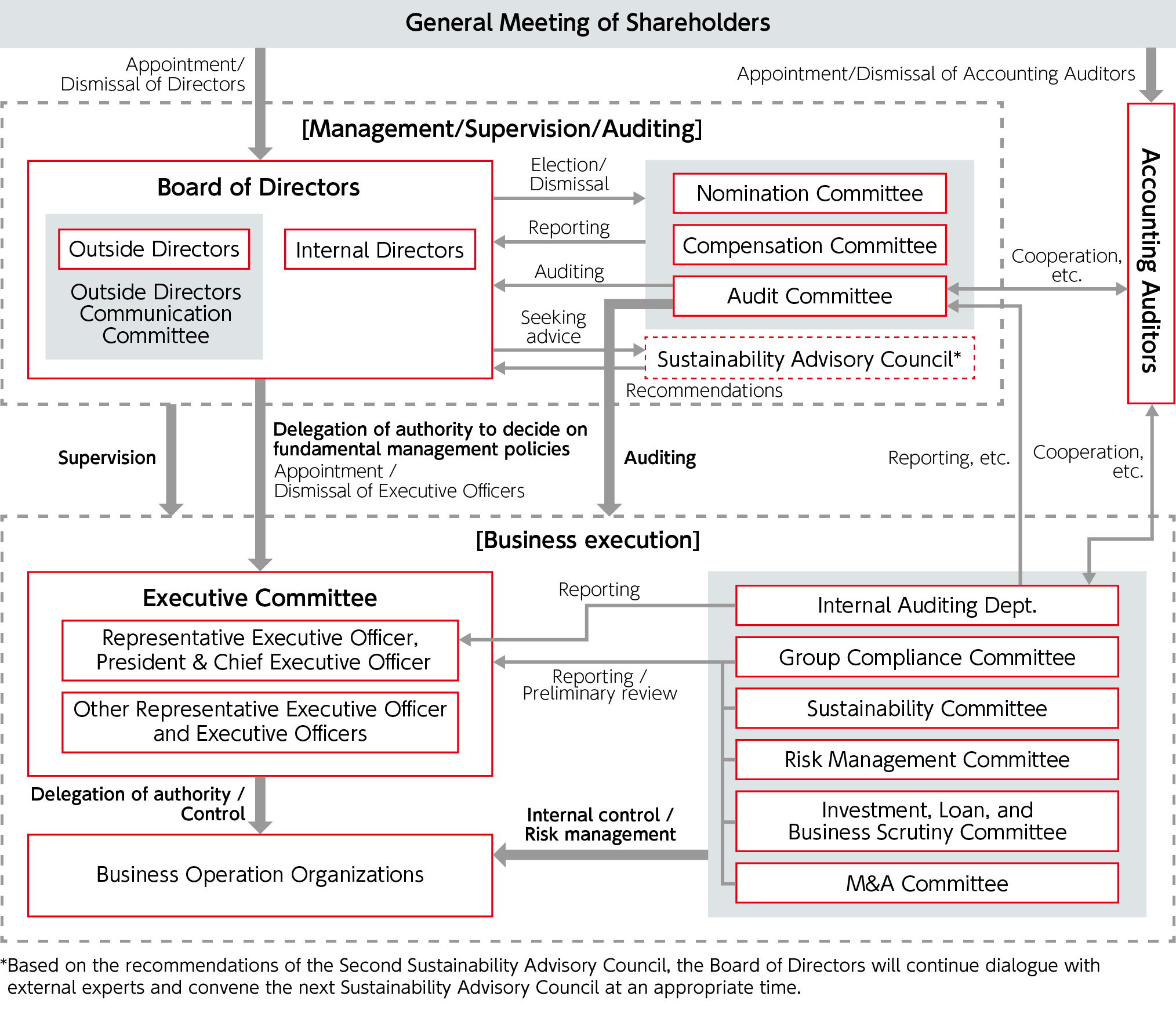
The Board of Directors, as the highest decision-making body for management, indicates a major direction by discussing and examining important management matters that greatly affect corporate value, supports risk-taking in execution, and supervises appropriate executions that reflect the opinions of stakeholders by verifying the validity of execution processes and results. Additionally, through the ASV Management, the Company works with stakeholders and others to resolve social issues, contributes to the realization of a sustainable society, and takes responsibility for sustainable enhancement of corporate value.
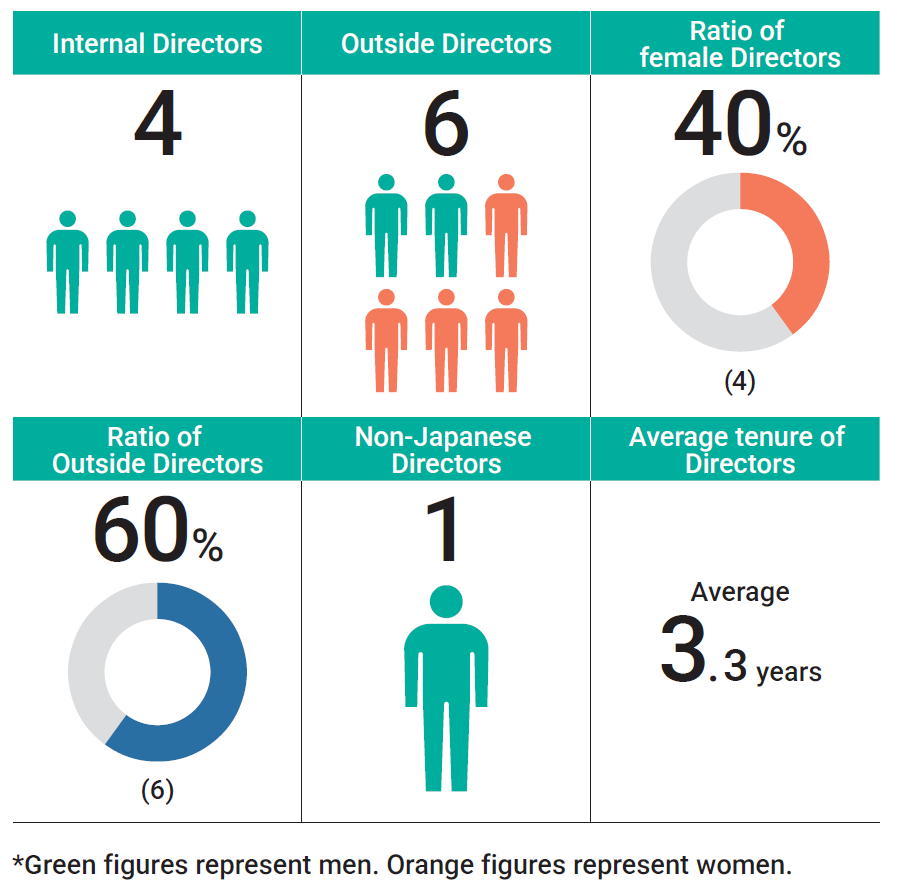
The Company has the basic policy, considering the number of members, the percentage of Internal Directors and Independent Directors, the percentage of persons who concurrently serve as Directors and Executive Officers, individual experiences, abilities, insights, internationality, gender, race, ethnicity, nationality, country of origin or cultural background, etc., for the Board of Directors composed of Independent Directors who can objectively supervise business execution from an independent standpoint, Internal Directors who concurrently serve as Executive Officers including Chief Executive Officer, and Internal Directors who are Member of the Audit Committee (Standing).
In addition, in order to promote the separation of supervision and execution and further enhance the effectiveness of the management oversight function by the Board of Directors, the Independent Directors shall occupy a majority, and the Chair of the Board of Directors shall be the Independent Director.
|
* Up to four expected skills are listed for each Director and do not represent all skills held.
|
Skills |
Definition |
Reasons for selection |
|---|
|
① Management Strategy |
Skills to realize enhancement of corporate value through sustainable growth by gaining thorough knowledge of business, and through supervising and promoting an appropriate strategy that is conscious of capital markets |
As a company that contributes to the well-being of all human beings, our society and our planet with AminoScience®, these skills are essential to dramatically increase the corporate value of the Ajinomoto Group through the promotion of Ajinomoto Group Creating Shared Value (ASV) management |
|
② Global |
Skills to supervise and promote appropriate strategies for global business development based on diverse values and cultures |
These skills are essential for appropriate supervision and promotion of business execution based on understanding of diverse values and cultures for the sustainable global expansion of business domains |
|
③ Sustainability |
Skills to supervise and promote appropriate strategies for resolving social issues through business to realize a sustainable society |
These skills are essential to achieve "the extension of healthy life expectancy for 1 billion people" and "the reduction of our environmental footprint by 50%" through ASV management that achieves both social value and economic value |
|
④ Digital |
Skills to supervise and promote appropriate strategies for innovation and improvement of productivity, etc. by making full use of IT and digital technologies |
These skills are essential for transforming into a company that contributes to the well-being of all human beings, our society and our planet with AminoScience® while enhancing our corporate value by raising our competitiveness, efficiency, and productivity through DX |
|
⑤ R&D / Production |
Skills to supervise and promote appropriate strategies for constantly pursuing innovative R&D as well as safe and secure products and services |
These skills are essential to achieve "the extension of healthy life expectancy for 1 billion people" and "the reduction of our environmental footprint by 50%" through innovation through AminoScience® |
|
⑥ Sales/ Marketing |
Skills to supervise and promote appropriate strategies to enhance brand value to accelerate growth in key businesses |
These skills are essential for growth through brand management that meets the values of the market and consumers and "Speed Up x Scale Up" |
|
⑦ Finance & Accounting |
Skills to supervise and promote appropriate strategies based on advanced expertise in finance, accounting, and tax matters |
These skills are essential to maximize corporate value through ASV management, to formulate and promote strategies that realize both investment for growth and shareholder returns, and to ensure appropriate supervision of business execution |
|
⑧ HR/ HR Development |
Skills to supervise and promote appropriate strategies for each and every diverse human resource to develop and maximize their abilities |
These skills are essential to evolve ASV management by strengthening human assets, which are the driving force for the enhancement of the value of all intangible assets, through the cogrowth of individuals and organizations |
|
⑨ Legal Affairs/ Risk Management |
Skills to supervise and promote appropriate strategies to realize sustainable enhancement of corporate value through legal compliance, corporate governance and risk management |
These skills are essential to steadily and stably promote ASV management by realizing sustainable enhancement of corporate value through penetration and implementation of Ajinomoto Group Policies (AGP)* |
*Note: The Ajinomoto Group Policies (AGP) set out the beliefs and behaviors to which all Ajinomoto Group companies and each of those who work there are committed. The AGP serves as a written pledge to all stakeholders that Ajinomoto Group personnel will work earnestly to uphold these beliefs and behaviors.
The objective of the Company’s Board of Directors is to indicate a major direction by discussing and examining important management matters that greatly affect corporate value, to support risk-taking in execution, and to supervise business execution through verifying the appropriateness of the execution process and results. In light of this objective of the Board of Directors, the Board of Directors adopts methods it considers to be the most optimal for the evaluation of its own effectiveness from various analytical and evaluation methods, and conducts analyses and evaluations of its own effectiveness. In addition, based on the results of the evaluation of effectiveness, the Board of Directors discusses the issues, and sets and conducts initiatives for improvement against those issues that are identified. Through these efforts, the Company further improves the effectiveness of the Board of Directors and further enhances corporate governance.
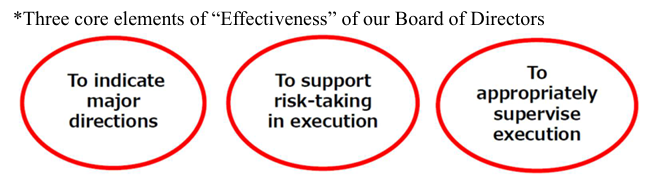
The “Effectiveness” of our Board of Directors:
How appropriately the Board of Directors fulfill its objective of properly indicating major directions by discussing and examining important management matters that greatly affect our corporate value, supporting risk-taking in execution, and appropriately supervising execution by verifying the validity of execution processes and results.

- Evaluate, as a Board of Directors, what is required to enhance the effectiveness of the Board.
- The questionnaires and interviews are designed with original questions, and their content is updated annually.
- Implement a PDCA cycle, including interim reporting on the status of initiatives to improve effectiveness following the evaluation.
|
Nomination Committee |
Compensation Committee |
Audit Committee |
|---|
|
Member |
Five outside directors |
Four outside directors |
Four outside directors One internal director(Full-time Audit Committee) |
|
Chair- person |
Outside director |
Outside director |
Outside director |
|
Rule |
The Nomination Committee deliberates on validity of the evaluation and reappointment of Directors, on validity of the evaluation and reappointment of Representative Executive Officer & Presidents, and on succession planning of the Representative Executive Officer & President, etc. |
The Compensation Committee deliberates and decides matters related to remuneration for Directors and Executive Officers in order to determine the remuneration of Directors and Executive Officers fairly and appropriately. |
The Audit Committee plays an important role in the function of “supervision of business execution” by the Board of Directors by auditing the legality and appropriateness of Executive Officers and Directors' business execution. |
| The composition of each committee will be as follows. | ||||||||||||||||||||||||||||||||||||||||||||||||||||||||||||||||||
|
※Circles (○) indicate members, double circles (◎) indicate the chairperson or committee chair, and asterisks (*) indicate in-house directors who serve as full-time Audit Committee members.
Matters related to policies on the content of individual compensation, etc. for Directors and Executive Officers are decided by the Compensation Committee
Basic Policy regarding the determination of compensation for Directors and Executive Officers
- Compensation must conform to the Ajinomoto Group Policy (AGP), and lead to medium- to long-term expansion of the corporate value.
- Compensation must be at a level that is sufficiently competitive compared with market standards.
- Details on compensation must be explainable to stakeholders and be decided in a transparent process
【 Compensation of Outside Directors and Internal Directors Serving on the Audit Committee 】
Consists of basic compensation only, paid in a fixed amount in cash each month.
【 Compensation for executive officers (including those who also serve as directors) 】
Consists of basic compensation, Short-term Incentives, and Medium-term Stock-based Incentives.
|
Basic compensation (monthly) |
Fixed compensation to fully demonstrate one's qualities and abilities and fulfill one's responsibilities |
|---|
|
Short-term Incentive (one time/ year) |
Performance-linked compensation to encourage the achievement of annual performance targets and appropriate management |
|---|
|
Medium-term performance linked stock compensation (once every three years) |
Performance-linked stock compensation to be paid every three fiscal years, with the aim of achieving sustainable performance improvement and increasing corporate value over the medium to long term. |
|---|
Directors, Representative Executive Officer & President (hereinafter referred to as the “CEO”) will be paid the Basic Compensation, the STI, and the MTI at approximately 25:25:50 (on an annual basis*) at the time of achieving the standard performance target. Executive Officers will be paid at approximately 50:25:25.
* “On an annual basis” means when the MTI to be paid after the end of the 3-Year Period would be leveled and paid annually.
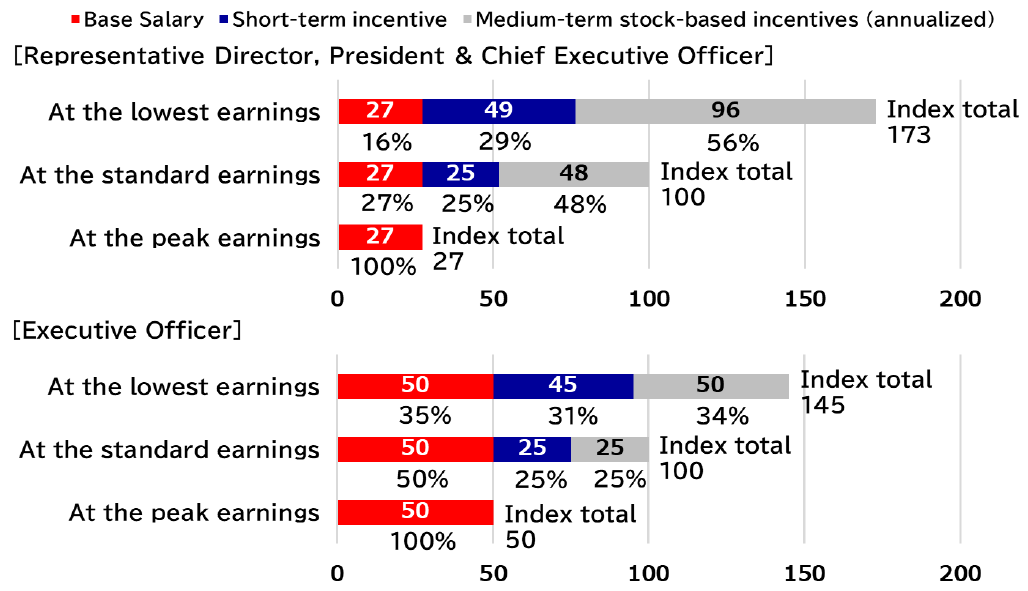
President & Chief Executive Officer is evaluated only based on the Company-wide Performance. Other Executive Officers are evaluated based on the Company-wide Performance and the Individual Performance, and the weight of the evaluation of the Company-wide Performance and the Individual Performance is generally 1:1.
|
Compensation based on the Company-wide performance |
Determined using the following formula Compensation based on the Company-wide performance = base amount by position × Evaluation indicators (*) |
|---|
|
Compensation based on the individual performance |
The Compensation Committee resolves on the evaluation of individual performance and determines the compensation amount based on a predetermined compensation table |
|---|
(*) The evaluation indicators are calculated based on the sum of the following three elements.
If the achievement rate of each evaluation indicator exceeds 1.2, the upper limit shall be 1.2.
Achievement rate ≥ 100%
(Consolidated Sales achievement rate × 5 - 4) × 1/3
(Consolidated business profit achievement rate × 5 - 4) × 2/3
Achievement rate < 100%
(Consolidated Sales achievement rate × 2.5 - 1.5) × 1/3
(Consolidated business profit achievement rate × 2.5 - 1.5) × 2/3
The following table shows the metrics, target values and evaluation weights of the MTI.
|
||||||||||||||||||||||||||||
(NOTE 1) The evaluation index for each indicator is calculated using the following formula.
(Achievement rate × 2.5 - 1.5) × Evaluation weight
If the achievement rate of each evaluation indicator exceeds 1.4, it is capped at 1.4.
The achievement rate for each indicator is calculated using the following formula.
FY2028 actual value ÷ FY2028 target value × 100%
(NOTE 2) ROIC (Return on Invested Capital) is calculated using the method shown below (all values are on a consolidated basis).
∴ ROIC = (Operating income after tax for the fiscal year) ÷ [(Capital invested in that fiscal year) + (Capital invested in the previous fiscal year) ÷ 2] * Invested capital = Shareholders' equity attributable to the owners of the parent company + interestbearing debt
(NOTE 3) Relative TSR is calculated using the method shown below.
∴ Relative TSR = (Total shareholder return on the last day of the most recent fiscal year) ÷ (TOPIX total shareholder return including dividends for the period corresponding to the Company's total shareholder yield calculation period)
(NOTE 4) The greenhouse gas emission reduction rate is evaluated for each Scope, and the achievement rate against the FY2028 target value is calculated from the average.
(NOTE 5) The headcount of extending the healthy life expectancy is evaluated, and the achievement rate against the FY2028 target value is calculated.
(NOTE 6) The employee engagement is evaluated based on the average of 9 questions in the "ASV Realization Process," and the achievement rate against the FY2028 target value is calculated.
(NOTE 7) The Corporate brand value is evaluated by using the “Best Japan Brands” published by Interbrand and the achievement rate against the FY2028 target value is calculated.