June 20, 2005 - Tokyo - Ajinomoto Co., Inc. (Ajinomoto, President & CEO: Kunio Egashira; Headquarters: Tokyo, Japan) will invest approximately \15 billion to expand its production capacity for feed grade amino acids and umami seasonings. By doing so, it plans to strengthen its competitive advantage and further expand demand for its amino acids business, in which the company holds a strong number-one position.
Demand is increasing substantially in the feed-use amino acids and umami seasonings markets, and Ajinomoto is pursuing a two-fold business strategy of providing a stable supply to the markets while improving profitability through cost reductions.
In its 2005-2010 Medium-to Long-Term Management Plan, Ajinomoto plans to reinforce its strong number-one position and expand its business base with a basic four-part strategy of expanding markets and strengthening its competitive advantage, retail business and research and development. Ajinomoto aims to achieve net sales of \410 billion and operating income of \63 billion in its amino acids business, which includes feed-use amino acids, amino acids for pharmaceuticals and foods, umami seasonings and amino acid-based sweeteners.
Specific details of the expansion areas are as follows.
| 1. |
In the area of feed-use amino acids, Ajinomoto will increase production of Tryptophan at AJINOMOTO EUROLYSINE S.A.S. in France. Total capital expenditure will be approximately \4.79 billion (EUR 35.1 million), which will include expanding production of Lysine and Threonine through efficient investment in common facilities. |
| |
・ |
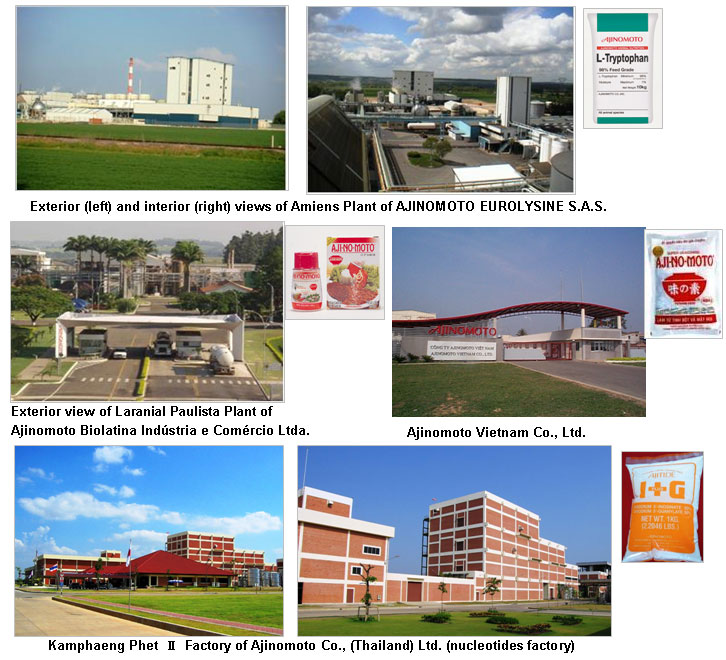
Ajinomoto will double production capacity of feed grade Tryptophan at the Amiens Plant (Amiens, France) of its subsidiary AJINOMOTO EUROLYSINE S.A.S. (President: Jean Falgoux; Headquarters: Paris, France) in order to meet rapidly expanding demand, mainly in Europe. (Annual production capacity will be increased from 1,300MT to 2,800MT, with completion of construction scheduled at the beginning of 2007.) |
| |
|
| The current size of the market for feed-use amino acids is approximately 800,000MT for Lysine (with a projected annual growth rate of 8%), approximately 65,000MT for Threonine (with a projected annual growth rate of 20%) and1,500MT for Tryptophan (with rapid growth projected). To respond to this brisk demand, by fiscal 2010 Ajinomoto plans to increase production of Lysine to 500,000MT (approximately two times, for a market share of more than 35%), Threonine to 140,000MT (approximately thee times, for a market share of more than 70%) and Tryptophan to 5,000MT (approximately four times, for a market share of more than 80%). In accordance with this long-term plan, Ajinomoto will successively increase production capacity of Lysine and Threonine at their plants in six countries worldwide as well as at a new production base. |
|
| 2. |
In the area of umami seasonings, Ajinomoto will invest approximately \9.5 billion to expand production of AJI-NO-MOTO (monosodium glutamate) and nucleotides in Brazil, Vietnam and Thailand. The umami seasonings market is Ajinomoto’s core business area, and the company will continue to invest aggressively to provide services closely linked to each region. |
|
| |
1) AJI-NO-MOTO
Ajinomoto will invest a total of approximately \4.5 billion in Brazil and Vietnam to increase total production by about 35,000MT. The MSG global market is approximately 1,700,000MT (with a projected annual growth rate of 4%), and Ajinomoto’s share is approximately 34%. |
| |
(A) |
Brazil
Ajinomoto will invest approximately \2.73 billion (US$26 million) in the Laranjal Paulista Plant of Ajinomoto Biolatina Indústria e Comércio Ltda. (completion of construction scheduled for second half of 2006) to raise annual production capacity of Ajinomoto’s two Brazilian subsidiaries (Ajinomoto Interamericana Indústria e Comércio Ltda. and Ajinomoto Biolatina Indústria e Comércio Ltda.) from 130,000MT to 150,000MT. Ajinomoto’s products in Brazil have the highest level of cost competitiveness of any of its products worldwide, and are supplied to the Americas, Europe, Africa and Asia and Pacific.
Brazil is the world’s top producing country of sugar cane, the main raw material of MSG. Thanks to its abundance and effective utilization of by-products generated by the fermentation process, Ajinomoto’s operations in Brazil have achieved the world’s highest level of cost competitiveness, and will meet increasing demand in Europe, Africa and Asia as well as the Americas. |
| |
| |
(B) |
Vietnam
Ajinomoto will invest approximately \1.72 billion (approximately US$16.4 million) in Ajinomoto Vietnam Co., Ltd. to increase annual production capacity from 45,000MT to 60,000MT (completion of construction scheduled for mid-2006).
Ajinomoto plans to achieve further penetration of the AJI-NO-MOTO brand and make it better established in Vietnam’s strongly growing domestic retail MSG market, and will strengthen supply to the rapidly growing processed foods market. |
| |
|
|
| 2)Nucleotides |
| |
Ajinomoto will double the annual production capacity of the Kamphaeng Phet 2 Factory of Ajinomoto Co., (Thailand) Ltd. to 6,600MT in order to strengthen global supply capability (completion of construction scheduled for second half of 2006). Investment will total approximately \4.96 billion (approximately THB 1.89 billion). The size of the nucleotides market in the world is approximately 15,000MT (with a projected growth rate of over 6%) and Ajinomoto’s share is approximately 40 percent.
Since the start of operations in 2003, the Kamphaeng Phet 2 Factory has continued stable production, achieved its initial targets for production volume and costs and introduced Ajinomoto’s innovative technologies to achieve the world’s strongest cost competitiveness. The current increase in production is aimed at further reducing production costs and strengthening the earnings base. Ajinomoto is the leader in the umami seasonings market, which continues to grow strongly. In order to secure stable supply for growing demand and further strengthen its strong number-one position in the global market, Ajinomoto will optimize and increase production at factories that have the world’s highest level of cost competitiveness and successively enhance production capacity in expanding markets.
In the umami seasonings global market, MSG is expected to increase to 2,100,000MT and nucleotides to 22,000MT in 2010. In order to increase its market share, Ajinomoto plans to further enhance production capacity following the above initiatives.
|
| |
| Overview of Investments |
| |
Products |
Country |
Company |
Total
Investment
(Approximate) |
| Feed grade amino acids |
Tryptophan,
Threonine,
Lysine |
France |
AJINOMOTO EUROLYSINE S.A.S. |
\4.79 billion |
| Umami seasonings |
MSG |
Brazil |
Ajinomoto Biolatina Indústria e Comércio Ltda. |
\2.73 billion |
| Vietnam |
Ajinomoto Vietnam Co., Ltd. |
\1.72 billion |
| Nucleotides |
Thailand |
Ajinomoto Co., (Thailand) Ltd. |
\4.96 billion |
| [REFERENCE] |
1. |
Feed-Use Tryptophan |
| |
Tryptophan is Ajinomoto’s third major feed-use amino acid after Lysine and Threonine, and Ajinomoto is working to develop its demand. Tryptophan is, in general, the third limiting amino acid for swine after Lysine and Threonine. As with these two feed-use amino acids, using Tryptophan as an additive helps, improve feed efficiency and promote animal growth. In addition, substituting Tryptophan for natural protein sources contributes to saving those precious resources, lowering the dietary protein level and alleviating environmental pollution caused by nitrogen excreted in manure. Although Tryptophan use is currently limited in piglet feeds, Ajinomoto is further developing the Tryptophan market, which is expected to grow rapidly, with stable supply worldwide. |
|
| 2. |
AJINOMOTO ANIMAL NUTRITION Group |
| |
The mission of the AJINOMOTO ANIMAL NUTRITION group is to contribute to the efficient use of limited food resources, to reduce the environmental load, and to produce healthy, safe, and tasty food products through development of applications for feed-use amino acids. The AJINOMOTO ANIMAL NUTRITION group will continue to guarantee a stable supply of high-quality feed grade amino acid products and offer services tailored to each region to support customers worldwide. |
AJINOMOTO ANIMAL NUTRITION Group
AJINOMOTO EUROLYSINE S.A.S. (France)
AJINOMOTO BIOITALIA S.p.A. (Italy)
Ajinomoto Heartland LLC (U.S.A.)
Ajinomoto Co., (Thailand) Ltd. (Thailand)
Chuanhua Ajinomoto Co., Ltd. (China)
Ajinomoto Biolatina Indústria e Comércio Ltda. (Brazil) |
| 3. |
Nucleotides |
| |
Nucleotide produce a stronger, richer taste through a synergistic effect with MSG. They are used in a wide range of processed foods such as soups (including instant noodle soups) and flavored seasonings. |
4. |
Profiles of Companies (as of April 1, 2005) |
| |
1.Profile of AJINOMOTO EUROLYSINE S.A.S. |
| |
|
Name: |
AJINOMOTO EUROLYSINE S.A.S. |
| |
|
Established: |
August 1974 |
| |
|
Head Office: |
Paris, France |
| |
|
President: |
Jean Falgoux |
| |
|
Main Products: |
Feed grade Lysine, Threonine and Tryptophan |
| |
|
Capital: |
EUR 26,865,000 |
| |
|
Number of Employees: |
297 |
| |
|
|
|
| |
2.Profile of AJINOMOTO EUROLYSINE S.A.S. Amiens Plan |
| |
|
Location: |
Amiens, Prefecture de la Somme, France |
| |
|
Start of Production: |
May 1976 |
| |
|
Plant Manager: |
Pierre Lucq |
| |
|
Production Capacity: |
Lysine 70,000MT/year, Threonine 35,000MT/year, Tryptophan 1,300MT/year |
|
| |
3.Profile of Ajinomoto Biolatina Indústria e Comércio Ltda. |
| |
|
Name: |
Ajinomoto Biolatina Indústria e Comércio Ltda. |
| |
|
Established: |
June 1975 |
| |
|
Head Office: |
São Paulo, SP, Brazil |
| |
|
President: |
Yoshihiko Sakai |
| |
|
Main Products: |
Umami seasoning AJI-NO-MOTO (monosodium glutamate), feed grade Lysine, etc. |
| |
|
Capital: |
BRL 131,707,000 |
| |
|
Number of Employees: |
344 |
| |
|
|
|
| |
4.Profile of Ajinomoto Biolatina Indústria e Comércio Ltda. Laranjal Paulista Plant |
| |
|
Location: |
Laranjal Paulista, SP, Brazi (approximately 160 km northwest of the City of São Paulo |
| |
|
Plant Manager: |
Massao Ura |
| |
|
Start of Production: |
May 1977 |
| |
|
Number of Employees: |
160 |
| |
|
|
|
| |
5.Profile of Ajinomoto Vietnam Co., Ltd. |
| |
|
Name: |
Ajinomoto Vietnam Co., Ltd. |
| |
|
Established: |
February 1991 |
| |
|
Head Office: |
Dong Nai Province, Vietnam (approximately 30 km northwest of Ho Chi Minh City) |
| |
|
President: |
Tamotsu Iwamoto |
| |
|
Main Products: |
Umami seasoning AJI-NO-MOTO (monosodium glutamate), flavor seasonings, etc. |
| |
|
Capital: |
Approximately US$45,000,000 |
| |
|
Number of Employees: |
510 |
| |
|
|
|
| |
6.Profile of Ajinomoto Vietnam Co., Ltd. Bien Hoa Plant |
| |
|
Location: |
Dong Nai Province, Vietnam |
| |
|
Plant Manager: |
Yuji Mizuta |
| |
|
Start of Production: |
January 1993 |
| |
|
Number of Employees: |
240 |
| |
|
|
|
| |
7.Profile of Ajinomoto Co., (Thailand) Ltd. |
| |
|
Name: |
Ajinomoto Co., (Thailand) Ltd. |
| |
|
Established: |
April 1960 |
| |
|
Head Office: |
Bangkok, Thailand |
| |
|
President: |
Kanji Mimoto |
| |
|
Main Products: |
Seasonings, food products, feed grade amino acids, etc. |
| |
|
Capital: |
THB 796 million |
| |
|
Number of Employees: |
980 |
| |
|
|
|
| |
8.Profile of Ajinomoto Co., (Thailand) Ltd. Kamphaeng Phet 2 Factory |
| |
|
Location: |
Kamphaeng Phet Province, Thailand |
| |
|
Plant Manager: |
Yoshinari Shiroshita |
| |
|
Start of Production: |
November 2003 |
| |
|
Number of Employees: |
116 |
For further information please contact:
Ajinomoto Co., Inc. Corporate Communications Department; Tel: +81-3- 5250-8180 |
|
